
Cork factory tour at Novacortica. That is the name of a cork factory in the Algarve. Visiting a cork factory while being in Portugal is a must. And at Novacortica you will learn so much about cork – and it is fun stuff. Stuff like – did you know that a cork for a wine bottle can cost up to five euros?
Table of Contents
Novacortica – Enjoy a cork factory tour and learn all about cork

Our guide, Caterina, was really great. She made cork super interesting, and we got many fun facts about the cork industry. When you enter this place, you walk right into a store. There, they are selling stuff that is made out of cork. I was looking for a world map in cork, and unfortunately, they don’t have that (but no worries – I found it in another store and bought it). The cork is of the same quality as leather.
If you want your own cork map, you can click on the picture to the right. That will take you to Amazon, and if you buy it, we will get a small kickback.
Learning about the history of cork is just one of many incredible cultural experiences in this country. If you are planning an unforgettable journey and want to discover more routes, check out our complete Portugal travel guides.

Everything cork at the cork factory
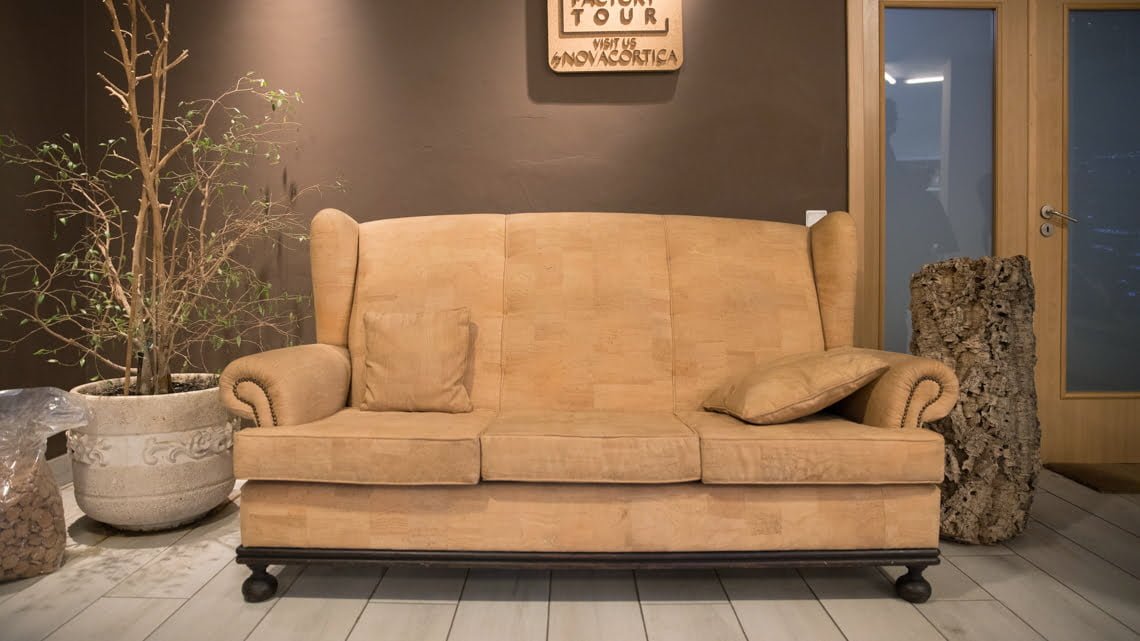
Who knew that you can buy clothes that are made of cork? Well, we didn’t, but now we know! They even have a sofa made out of cork. The thing is that the bark of the cork is really strong and resistant, something that makes it perfect for use in furniture and clothes. All over Portugal, you can buy cork in all shapes and sizes. You can buy bags and hats and also a lot of tacky things too.
However, at the Novacortica cork factory, they focus on champagne- and wine corks. No, that’s not totally correct. They focus on the plates that are later fused into wine corks. They have 50 acres of cork trees. All over Portugal, there are 735 000 acres, making it the biggest cork-producing country in the world.
After spending a fascinating morning discovering how cork is processed in the hills, head down to the coast for a fresh culinary reward. Don’t miss our guide on where and what to eat in Olhão, Algarve
The cork bark is harvested by hand
All the cork bark is harvested by hand – a craftsmanship that is becoming more and more forgotten. Ok, so let’s go back a bit and tell you how this whole process is made…
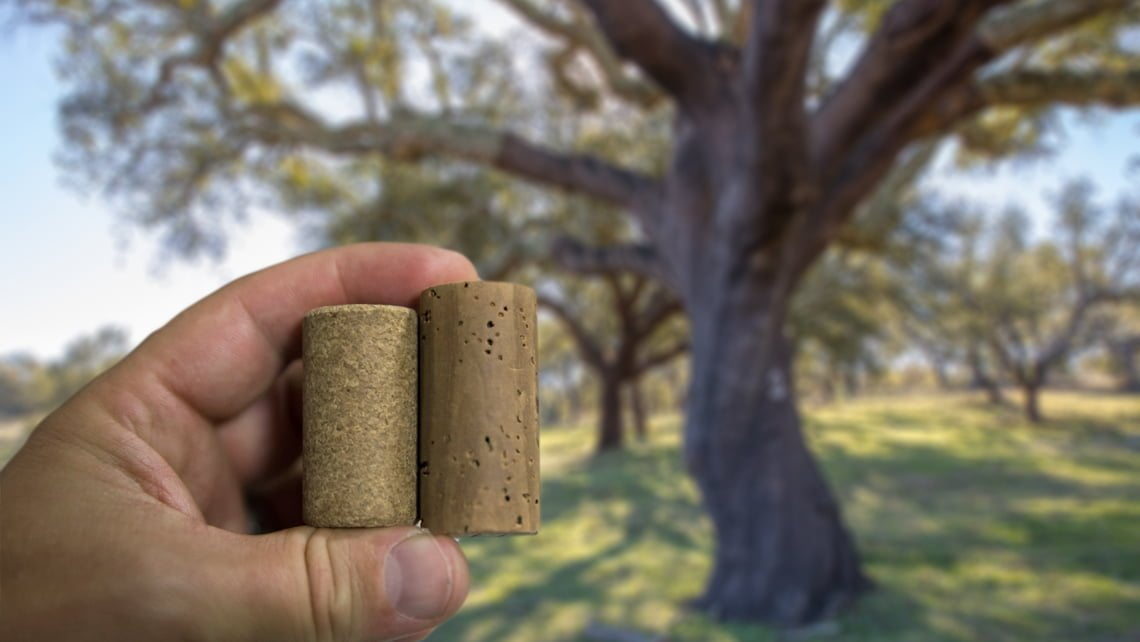
It starts with planting trees. After 25 years, it is time for the first harvest. That first harvest is of bad quality and is not good for making wine corks. So the bark is ground and used as building material.
In another nine years, it is time for the next harvest. Now the cork is of better quality, but it is still just ok. It is first after the third harvest that the cork becomes of great quality, 43 years after the tree was planted. The tree will be harvested every nine years for about 200 – 300 years; that is the lifespan of a cork tree. Imagine that the next time you open a cork on your favorite wine or champagne bottle, it is at least 43 years in the making.
Learning about the history of cork is a fantastic way to experience the heritage of the hills. If you want to combine this with another great local tradition near the coast, make sure to plan a visit to The Saturday market in Olhao
Numbers on the trees all over Portugal
If you drive in Portugal, you are bound to pass a lot of cork trees. If you look closely at the trees, you will see that they are painted with a number. The number gives you the last number in what year it was harvested. If there is a 7, it means that it was harvested in 2017 and will be harvested again in 2026. The trees take up a lot of space. You can’t grow them in rows because they need a lot of space.
The harvest is made in the late summer and is done by hand. They have tried over the years to get machines to harvest the cork, but that has not worked. And the “harvest” part is not something to be taken lightly. If you cut too deep into the tree, it will die. The people who are doing the harvest are older men. They make a lot of money (up to 150 euros per day). This is something that is passed down from father to son, and the industry is a bit worried that it is a dying work of art. Let’s hope that they make it trendy again!
While you ar exploring the beutiful coast and land of the algarve our tip is to go to the Sand city

Factories are working together to make the corks
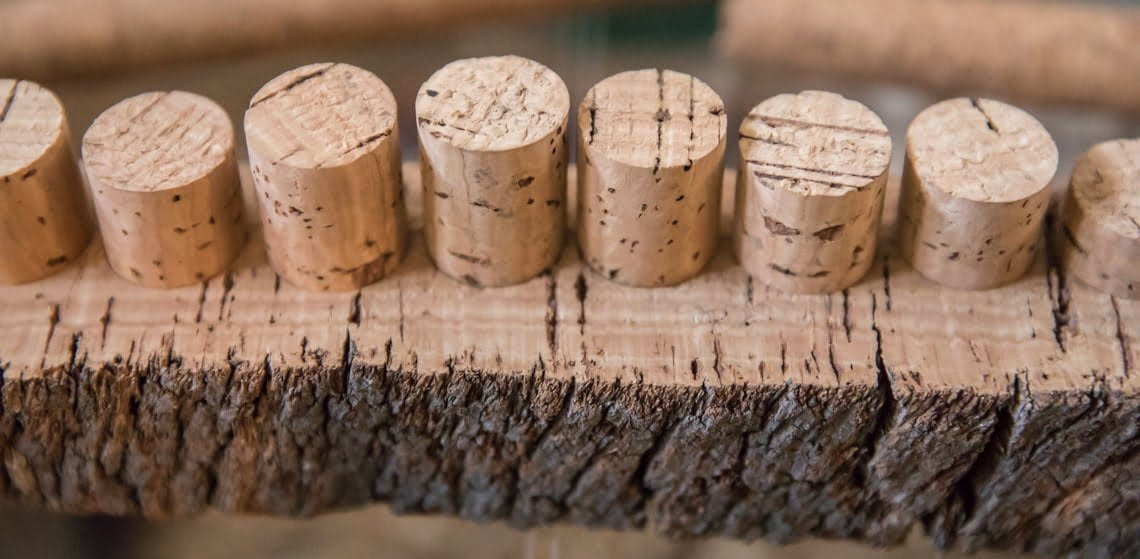
Our guide Caterina also taught us that making the wine- and champagne corks is a whole chain production. For example, at the Novacortica cork factory, they make the discs that make up the ground for the cork. If the cork is supposed to be used on a really nice bottle, they punch the whole cork in one move.
After the discs are cut out, they are sorted depending on quality. Every part of the cork is used during production, and there is no waste. After the cork discs are finished, they are sent to another company where they will get their stamp, and then they will be sent to yet another factory where the cork is put in the bottle.
What about the lack of cork and why not reuse the corks
We have heard that there is a lack of cork, and that’s why they are slowly changing to wine bottles, putting plastic corks or screw caps. According to our guide, there is no lack of cork. The thing is that it is a lot cheaper to use the other options. Caterina said that good quality wines will always have real cork in them. So my next question was whether you can reuse the corks that have been in wine bottles. The answer is yes, but it is not something that is done.
The reason why is that it is not good for the environment. Cork has an elastic memory. That means that the cork will come back to its original shape if you boil it in water. That would make it easy to put the cork into a new bottle. The problem is that boiling the cork is not enough. To get rid of all the wine that has been in contact with the cork before, you would have to add chemicals to the cork. And so it stops here – no reusing cork in bottles. But there are several things that you can do with your own wine corks. You can watch this video for inspiration!
Our cork factory tour at Novacortica
First, we got to sit in a room and got all the super interesting information about cork and the way it is produced. After that, we got to take a walk around the factory. When the cork has been harvested, it has to be boiled for one hour. The boiling procedure kills all the bugs that might be hiding in the bark, and it also makes it flat. My first thought was that it smelled like maple syrup in the boiling room.
Then we also got to see how they work with the sorting of the discs, and that work didn’t seem to be fun. However, the tour was incredible. The best part was all the super interesting information that we got. The tour itself was not the best part. The best part was sitting down and just listening to Caterina get us all the information. We really recommend you visit the Novacortica cork factory while in the Algarve. It is only about a 30-minute drive from Faro.
Fun facts about cork in the wine industry
- One single cork can cost up to five euros for the wine producer to buy. Good to know!
- 200 000 tons of corks are exported from Portugal each year.
- 70 percent of all the cork that is produced in the world comes from Portugal.
- The most expensive corks are sold and put in French bottles. Medium quality corks are found in Spanish wine bottles and the cheapest stuff in Italian wines. Now you know!

I got super inspired after we visited the Novacortica cork factory, and after our tour, I contacted a Swedish wine magazine, “Allt om Vin” and we ended up selling an article to them. The result turned out amazing, and to this day, this is one of the articles that we are most proud of!
Information about Novacortica cork factory

Address: Parque Industrial da, 8150-017, Portugal.
Opening hours: 09.00 – 17.00 daily, except for Saturday and Sunday when it is closed.
Phone number for reservations: +351 289 84 01 50.
Entrance fee: 12,50 euros per person.
Duration: About an hour and a half.




I will visit Algarve by the end of February. Is it possible to get a guided tour in the factory?